
By Elite Med Spa | Berwyn, IL
She’d already paid for six sessions somewhere else. Six sessions of laser hair removal on her legs and bikini area at a clinic she’d found online — decent reviews, reasonable price, not far from Berwyn. She went through the whole thing. Followed all the prep instructions. Shaved before each appointment. Avoided the sun. Came back every four to six weeks like she was told.
Six sessions later, the hair was still there. Not a little thinner, not slightly reduced — substantially still there. A few areas looked marginally better. Most didn’t. She felt like she’d wasted both time and money, and she’d started to wonder if laser hair removal just didn’t work on her.
It does work on her. That’s the short answer. And when she came into Elite Med Spa for a consultation, we were able to tell her exactly why her previous sessions hadn’t produced results — and what we would do differently.
This article is about that conversation. Because she is not the only person this has happened to. Not even close.
The First Question We Ask Every Patient Who Comes In After Failed Laser Elsewhere
Before we look at anything else, we ask about the equipment.
Not because we’re trying to disparage a competitor’s clinic — we’re not. But because in laser hair removal, the device matters enormously, and the word “laser” covers an enormous range of technology with wildly different capabilities.
There are medical-grade, clinical laser systems designed specifically for permanent hair reduction. And there are devices that get called “lasers” in marketing materials that are either low-powered diode systems, IPL machines (which are not lasers at all, technically), or older technology that was state-of-the-art fifteen years ago and has since been significantly surpassed.
When we asked her what device the other clinic used, she wasn’t sure. She knew it was described as a laser. That’s all.
This is unfortunately common. Most patients don’t know what device is being used on them — and many clinics don’t volunteer the information clearly because the answer wouldn’t always be reassuring.
What We Found: The Four Most Common Reasons Laser Hair Removal Fails
After her consultation, we identified what had likely gone wrong. In most cases of failed laser hair removal that we see from patients coming to us after treatment elsewhere, the cause falls into one or more of four categories.
Reason 1: Wrong Device for Her Skin Tone
This was almost certainly a factor in her case.
She has what would be described clinically as a Fitzpatrick skin type IV — an olive-to-medium brown complexion that is very common in Berwyn and the surrounding communities, particularly among patients with Hispanic, Middle Eastern, or Mediterranean heritage.
Here’s why this matters for laser hair removal: the laser targets melanin. Melanin is the pigment in the hair follicle that absorbs the laser energy, gets heated, and is destroyed. But melanin is also present in the surrounding skin. The goal is to deliver enough energy to destroy the follicle without damaging the skin around it.
On lighter skin tones, this is relatively straightforward — there’s a significant contrast between the dark hair follicle and the lighter skin, so the laser can be aggressive enough to destroy the follicle without much risk to the surrounding tissue.
On darker skin tones, that contrast is reduced. The melanin in the skin itself competes to absorb the laser energy. Use the wrong wavelength, and you risk burning the skin instead of — or in addition to — treating the follicle. Use settings that are conservative enough to avoid that risk, and you may not be delivering enough energy to effectively destroy the follicle.
This is where many clinics fail patients with darker skin. The solution is not to refuse treatment or to significantly underpower the laser. The solution is to use the right technology.
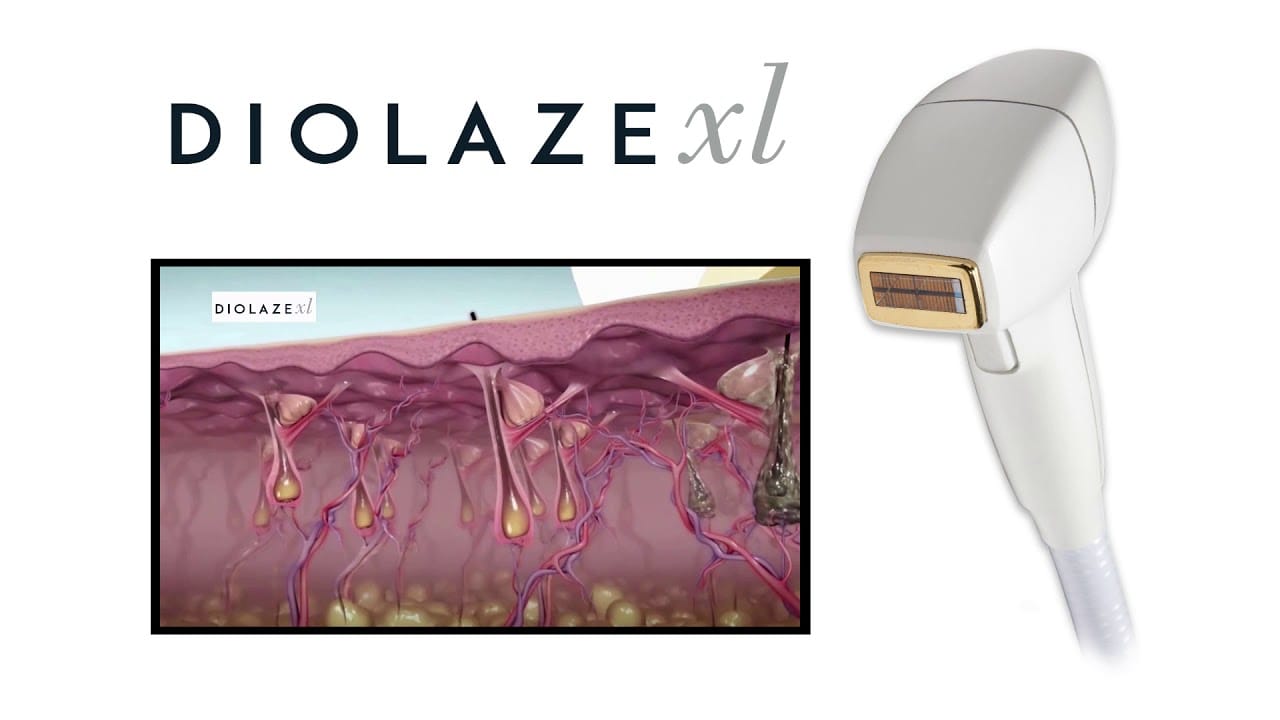
The Diolaze XL, which we use at Elite Med Spa, is a high-powered diode laser operating at 810nm — the wavelength considered the gold standard for laser hair removal across a range of skin tones including types III through V. It has a built-in cooling system that chills the skin immediately before, during, and after the laser pulse — which allows higher fluence (energy) to be delivered to the follicle while protecting the surrounding skin from thermal injury.
When we assessed her skin tone, we knew immediately that she needed different settings than a lighter-skinned patient would. At her first session with us, we calibrated the device to her specific Fitzpatrick type, test-pulsed a small area, observed the skin’s response, and proceeded accordingly.
This step — assessing skin tone and adjusting settings — should happen at every single session. Skin can tan between sessions. Hormonal changes, seasons, and other factors can affect how the skin responds. A fixed protocol applied the same way every time to a patient with her complexion is not appropriate care.
Reason 2: Incorrect Session Spacing
When she told us her previous clinic had been spacing her sessions every six weeks, consistently — we understood another piece of why the results were poor.
Hair grows in cycles. At any given time, the hair on any area of your body is in one of three phases:
Anagen — the active growth phase. The hair is actively growing from the follicle. This is the only phase during which laser hair removal is effective. The follicle must be actively connected to the hair shaft for the laser energy to travel down the shaft and destroy the follicle.
Catagen — a transitional phase. Brief, lasting only a couple of weeks.
Telogen — the resting phase. The hair has separated from the follicle and is essentially just sitting in the skin. Laser treatment during this phase has little to no effect on the follicle.
Different body areas have different proportions of hairs in each phase at any given time, and those proportions shift. The legs, for example, have a relatively long telogen phase — a significant percentage of leg hairs are in the resting phase at any given time. Bikini and underarm hair cycles somewhat faster.
A fixed six-week spacing between sessions, applied uniformly to all body areas, is not individualized care. It’s a scheduling convenience. For some areas on some patients, six weeks is appropriate. For others, 8–10 weeks between sessions would capture more hairs in the active growth phase and produce better results.
We adjusted her session spacing based on the body area being treated — which is a small change that makes a meaningful difference in outcomes over a full series.
Reason 3: Insufficient Fluence
This is the one that’s hardest to diagnose after the fact because we’re working from her experience and observations — but based on everything else we found, it’s likely a contributing factor.
Fluence is the energy delivered per unit area — measured in joules per centimeter squared (J/cm²). It is, in simple terms, how powerful each laser pulse is.
To permanently destroy a hair follicle, the laser must deliver enough energy to heat the follicle to a temperature that causes irreversible thermal damage. Too little energy, and the follicle is heated but not destroyed. It recovers. The hair grows back.
Why would a clinic use insufficient fluence? A few reasons.
One is appropriate caution — for a patient with a darker skin tone, a provider nervous about skin injury might dial back the energy to a level that’s safe for the skin but not adequate to destroy follicles. Well-intentioned, but it produces poor outcomes.
Another is equipment limitation — older or lower-powered devices may simply not be capable of delivering the fluence needed for effective treatment of certain hair and skin types at safe settings.
A third, less charitable, reason is throughput. High-fluence settings take more time and require more careful technique. Clinics running many patients back-to-back sometimes run lower settings because it’s faster and lower-risk for the provider — even if it’s less effective for the patient.
With our Diolaze XL system and her specific skin parameters, we were able to identify and use the appropriate fluence for her treatment — enough energy to effectively target follicles, delivered safely with the cooling system protecting the surrounding tissue.
Reason 4: Inadequate Pre-Treatment Preparation Guidance
This one surprised her a little.
She’d been told to shave before each session. That’s correct — the hair should be shaved to skin level so the laser energy is focused at the follicle and not absorbed by the hair shaft above the skin. She’d done that.
What she hadn’t been told: any sun exposure or self-tanner in the weeks before a session significantly increases the risk of skin injury and reduces treatment effectiveness for patients with her skin tone.
When melanin in the skin is elevated from recent sun exposure, the competition for laser energy between the skin and the follicle increases. The risk of surface skin reaction goes up. A responsible clinic either reschedules patients who show up with visible tanning, tests a small area first, or reduces energy settings — which circles back to the fluence problem.
She had been on vacation between two of her previous sessions and hadn’t been told to avoid the sun. She’d gotten some color. The clinic had treated her anyway at the same settings. She remembered those sessions being more uncomfortable than usual and seeing some surface redness that lasted longer than before.
That experience is exactly what happens when sun exposure guidance isn’t properly given and isn’t being monitored at each visit.
At Elite Med Spa, we ask about sun exposure, self-tanner use, and any skin changes at the start of every session — not just at the first appointment. It takes an extra sixty seconds and it matters.
What We Did Differently — And What Her Results Looked Like
We started her on a fresh series with our Diolaze XL system. We calibrated settings specifically for her Fitzpatrick type IV skin. We adjusted session spacing by body area. We gave her detailed pre-treatment instructions about sun avoidance and checked in about it at every session. And we used appropriate fluence — not conservative settings designed to avoid any possible reaction, but calibrated settings designed to actually destroy follicles while keeping her skin safe.
By session three, she was seeing the kind of reduction she’d been hoping to see after session three at her previous clinic. By session five, the treated areas were dramatically cleaner than after six sessions elsewhere.
She needed a full series with us — we want to be honest about that. We don’t have a way to “undo” the wasted sessions at the previous clinic. Hair follicles that weren’t adequately treated before may or may not have been partially damaged in ways that make them more or less responsive going forward. A new series with correct technique gives the best chance of achieving the permanent reduction she was looking for.
But the trajectory was completely different. The results were there.
Why This Happens More Than It Should
The laser hair removal industry has a real quality problem. The barriers to entry are low. Devices can be purchased by clinics with minimal staff training requirements. “Laser technician” certifications vary enormously in the depth of training they require. And from a patient’s perspective, one clinic’s “laser hair removal” looks identical on the surface to another’s — same treatment room, same paper gown, same laser-looking device.
The differences that actually determine whether you get permanent hair reduction or six wasted sessions aren’t visible in the waiting room. They’re in the device specifications, the provider’s training on how to use it, the skin assessment process, and the willingness to individualize settings rather than run a fixed protocol on every patient.
This is not a problem unique to any one neighborhood or price point. We see patients who’ve had unsuccessful treatment at expensive Chicago clinics and at budget options nearby. The common thread is almost never price — it’s process.
What to Ask Before You Start Laser Hair Removal Anywhere
If you’re considering laser hair removal in the Berwyn area — or anywhere — here are the questions worth asking before you book a series:
What device do you use, and what is the wavelength? A provider confident in their equipment will answer this directly. The 810nm diode laser is the gold standard. IPL is not a laser and is generally less effective for hair removal.
How do you calibrate settings for my specific skin tone? If the answer is “we have a standard protocol” rather than “we assess your Fitzpatrick type and adjust accordingly,” that’s worth noting.
Do you re-assess my skin at every session or just the first one? Skin changes. Settings should be adjusted throughout the series, not set once and forgotten.
What do you do if I’ve been in the sun between sessions? The answer should involve some form of assessment and possible adjustment — not “just come in anyway.”
How do you determine the session spacing? The answer should mention hair growth cycles and potentially vary by body area — not “every six weeks for everyone.”
If you’ve already been through a series somewhere else and didn’t get the results you expected — that doesn’t mean laser hair removal doesn’t work for you. In the majority of cases we’ve seen, the hair removal itself was never actually the problem. The process was.
Come In and Let Us Take a Look
If you’re in Berwyn, Cicero, Forest Park, Oak Lawn, Riverside, or anywhere in the surrounding area — and you’ve had laser hair removal that didn’t deliver what you were promised — we’d be glad to do a consultation.
We’ll look at your skin tone, talk through what was done previously, and give you an honest assessment of what we think is achievable with the right approach. No obligation. No pressure to book anything.
And if you haven’t started laser hair removal yet and want to do it right the first time — we can help with that too.
📍 6729 W 26th St, Berwyn, IL 60402 📞 855-293-1033 🌐 elite-med-spa.com/booking 🕘 Monday–Friday: 9 AM–4 PM | Saturday: 9 AM–2 PM
New patients receive 20% off their first treatment — use code NEW25 when booking.
Related Reading:

Leave A Comment